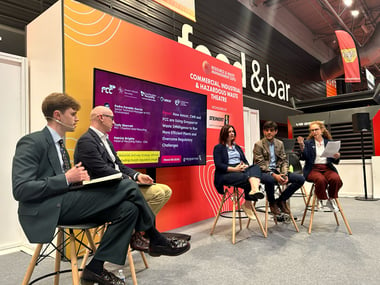
Manual sampling sees less than 1% of what moves through a recovery facility. At RWM 2026, our co-founder and CEO Mikela Druckman sat down to talk about what changes when the other 99% becomes visible: for operators, for regulators, and for the brands designing the packaging.
What AI means in a recovery facility
Most of the AI conversation is about large language models taking on writing and speech. In waste, the useful capability is vision.
AI is about teaching computers and machines to do tasks that we do as humans… within waste, we're really using that particularly with computer vision. So teaching computers to see what we see."
- Mikela Druckman, Co-founder & CEO of Greyparrot
That means recognising material type, estimating mass, telling a bottle from a can, and noticing a sleeve or a colour: what a trained person would see, applied continuously and at scale.
From spot samples to a live view of the plant
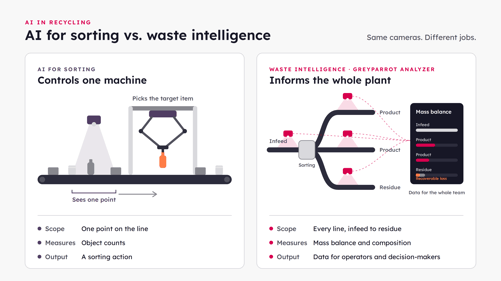
Greyparrot Analyzer units sit at in-feeds, product lines and residue to give operators a full picture of the facility. Instead of acting on a small sample, teams can respond to changes in the stream, purity loss or equipment problems as they happen.
Digital reporting, accepted by the regulator
Even facilities that had digitised their streams still had to sample by hand for regulatory reporting. Working with Biffa and FCC Environment, we went through the process with the Environment Agency. In 2026, FCC and Biffa became the first UK operators to submit AI-derived composition data, and the EA accepted it.
That was a huge milestone to shift from manual sampling to digital reporting, and I think we're going to see that increasing."
- Mikela Druckman, Co-founder & CEO of Greyparrot
Read the full FCC story in our RWM 2026 panel write-up.
How packaging performs in the real world
EPR has pushed waste data beyond the waste industry. Deepnest, launched last year, tracks how products actually behave inside recycling plants: whether they reach the right product line or end up in residue. It draws on 1 trillion waste detections.
BuzzBallz shows why this matters. Our data showed that 66% of BuzzBallz detected were ending up on plastic lines. They contaminated streams that were otherwise clean and recyclable.
If you build a format that's absolutely not fit, it will have a massive effect downstream, and we need more of that collaboration."
- Mikela Druckman, Co-founder & CEO of Greyparrot
Why this is a resource security question
We live in a super digitised world… But the moment we put something in the bin, we have no information and we don't know what happens."
- Mikela Druckman, Co-founder & CEO of Greyparrot
Mikela links material visibility to wider pressures: geopolitical shocks to oil prices, and demand for rare earths from data centres. Seeing every piece of waste valued as a resource is the reason Greyparrot was founded.
Upgrading the facility, not replacing the people
Asked about AI and jobs, Mikela said that in MRFs she has seen the opposite of the usual fear. Teams are being trained to work with data instead. One of Greyparrot's customers, KSI in the Netherlands, is using it as a recruitment tool for engineers wanting to work in an innovative manufacturing environment.
That's the thinking behind our new OEE dashboard. OEE (overall equipment effectiveness) is a standard manufacturing metric combining availability, performance and quality. The dashboard brings recovery facilities closer to how the rest of manufacturing runs.
Waste that competes with virgin material
For recovered material to replace virgin material, facilities have to produce consistent, high-quality commodities, and they can only manage what they can measure. As Mikela puts it, the goal is to help the industry get there with better data.