Two very different technologies in the recycling industry are both sold under the umbrella term "artificial intelligence." They use the same eyes (cameras mounted over a conveyor belt), but they have different brains, and they do fundamentally different jobs. Confusing the two is the most common mistake operators make when evaluating AI for a recovery facility.
This article explains how they differ in terms of technology and applications, and how to determine which one you actually need.
The short answer
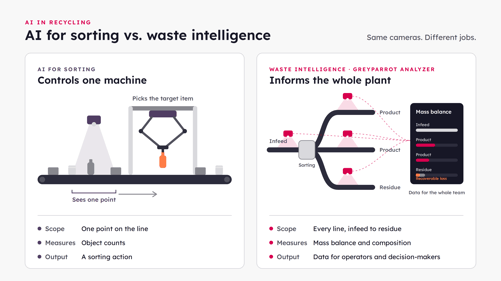
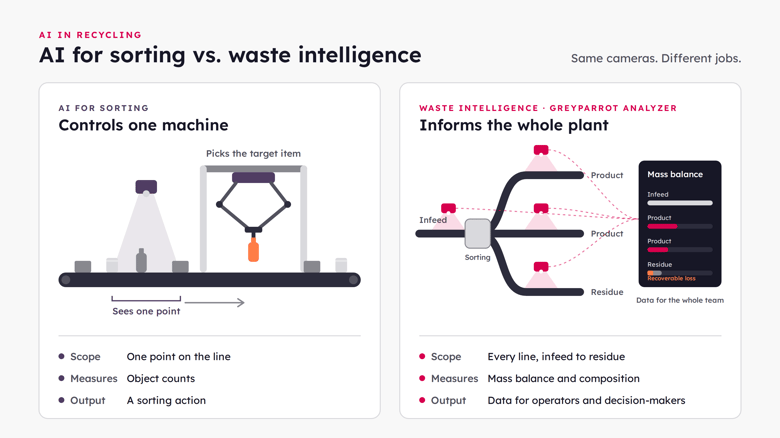
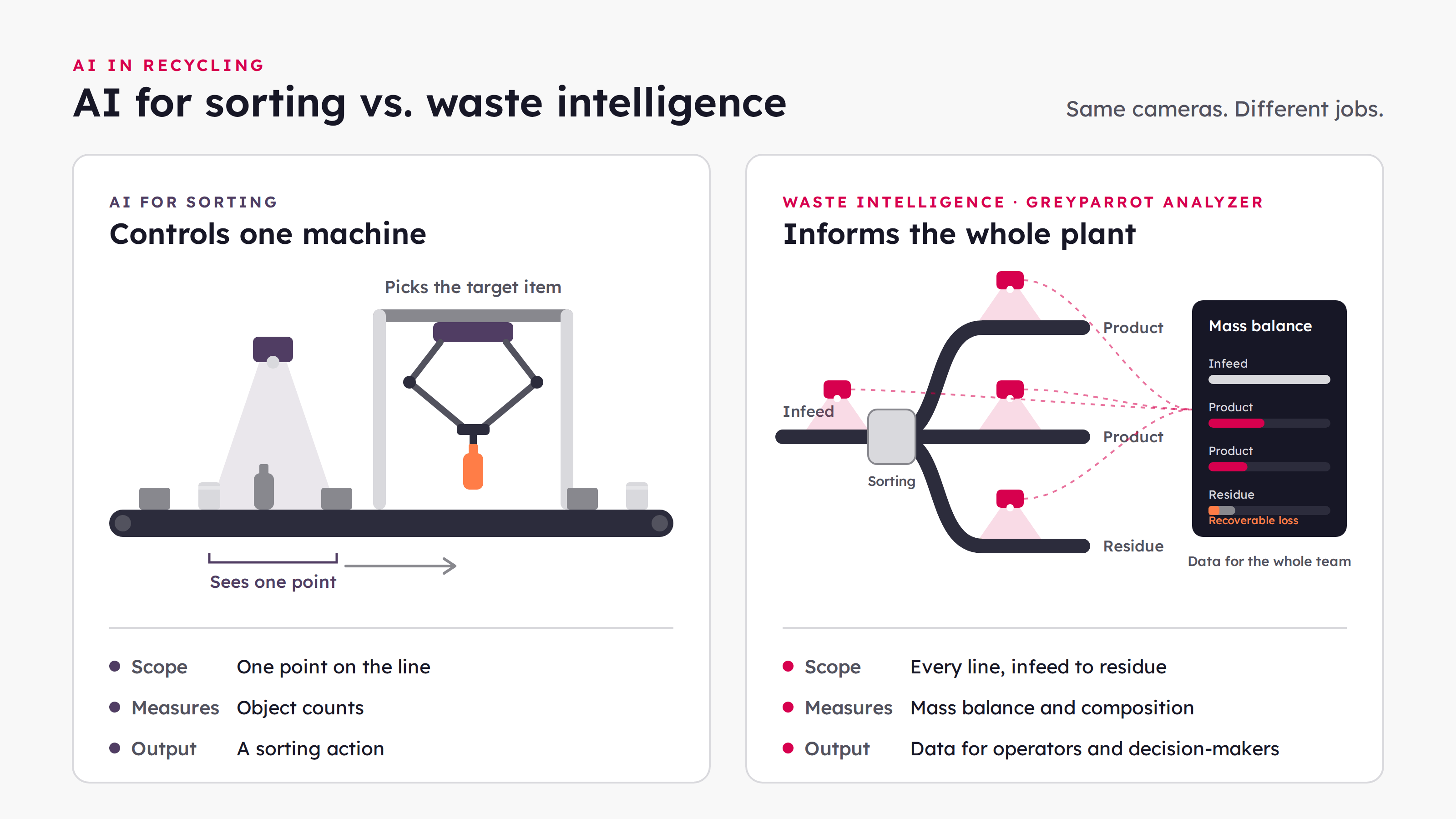
AI for sorting controls a single machine. It powers an optical sorter or robotic picker, deciding in real time whether to eject the item in front of it.
Waste intelligence informs the whole plant. It measures material across the full facility - every line, from infeed to residue - to quantify what material is present, where it flows, and what is lost. It produces actionable data for operators, engineers and commercial teams rather than driving a machine.
Neither replaces the other. One acts on a single point in the process; the other measures the process as a whole. Put another way: AI for sorting is quality control at a specific point, while waste intelligence provides quality and process assurance across the plant.
AI for sorting
AI for sorting is an actuation technology: its job is to make a physical decision at one location on the line. An optical or robotic sorter scans the material passing directly beneath it and fires an air jet or robotic arm to divert specific items.
Its defining characteristics:
- Scope: one point on the line - the position of that specific machine, typically a quality-control step, often towards the end of a line.
- Measurement: it primarily counts the objects it acts on. It can register other objects it sees, but it is not calibrated to measure the full mass or composition of the stream, so any such figures are far less accurate and will miss a large share of what passes through.
- Model: the model is calibrated to focus on the specific material or defect it needs to act on, not to produce an accurate overall material composition or mass estimation. For instance, some systems run a more centralised model, and these are still typically split by material stream (for example, a separate model for aluminium and for PET).
- Purpose: to drive the machine it controls - it is the system actually running the sorting decision, not just fine-tuning an existing one.
This technology is essential to modern sorting. Its limitation, for anyone trying to understand a facility overall, is that it sees only where it sits: a single point, not the full picture across the whole plant.
Waste intelligence
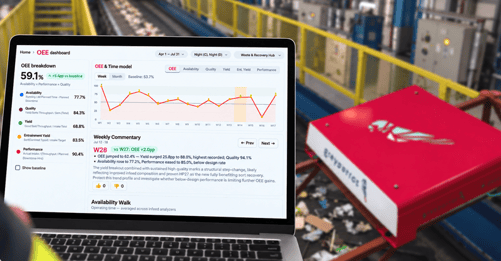
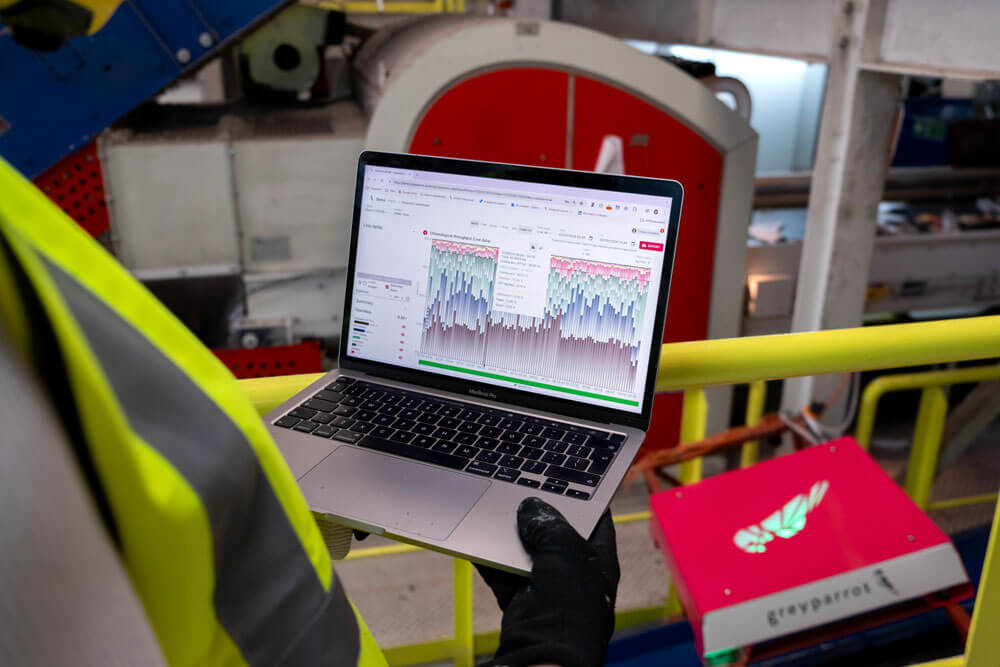
Waste intelligence is an analytics technology: its job is to measure, report and transform ways of working on site to be more data-driven. An AI waste analytics system such as Greyparrot Analyzer uses computer vision to identify material across every line in the plant and turns that continuous stream of observations into actionable insight - the definition of waste intelligence itself.
Its defining characteristics:
- Scope: every line across the plant, from infeed to all outputs, including the residue stream where recoverable material is often lost.
- Measurement: mass, not just counts - enabling a mass balance across the facility. That full-coverage mass balance is what turns waste data into plant optimisation: recovery, purity and yield loss decisions an operator can act on.
- Model: designed to measure the whole plant on a consistent basis, so every point and every facility is assessed the same way - making results comparable across sites and more robust to fluctuations. Providers build their computer vision differently: what defines waste intelligence is standardised, plant-wide measurement rather than a model tuned to a single machine.
- Purpose: to give the whole operation the data to maximise plant availability and performance and improve the quality of material produced - the metrics behind overall equipment effectiveness (OEE).
Because it is independent of any sorting-equipment vendor, the data it produces isn't graded by the company selling the machinery - which matters for compliance reporting, commercial negotiations and capital planning.
Side-by-side
| AI for sorting | Waste intelligence | |
| Primary job | Control one machine | Inform the whole plant |
| Coverage | One point on the line | Every line across the plant, infeed to product and residue lines |
| Measures | Object counts | Mass balance and composition |
| Model | Optimised to detect what to remove | Optimised to measure all material present |
| Independence | Tied to the equipment vendor | Independent of any vendor and hardware agnostic |
| Output | A sorting action | Data for operators and decision-makers |
How to tell which one you're being offered
Five questions quickly clarify what a given "AI" product does:
- Does it measure mass balance, or just object counts?
- How long has the company been training its model and deploying it for full plant optimisation, rather than sorting?
- Is the data independent, or produced by the company selling the machine?
- Does it give operators plant-wide data they can act on, or only the more limited output from a single machine?
- Is the product's purpose to improve whole-plant performance, or to perform the end clean-up of a single stream?
The bottom line
AI for sorting and waste intelligence are complementary, not competing. AI for sorting runs the sorting decision at a specific point, whether that's an AI-powered robot, an optical sorter or AI added to existing equipment for extra precision. Waste intelligence makes the facility measurable, and a facility you can measure is one you can improve. For operators, the useful question is not which technology is better in the abstract, but which one addresses the decision in front of them: a single sorting task, or visibility across the entire operation.
Evaluating AI for your facility? Download our AI buyer's guide.