Materials recovery facilities (MRFs) have always had a data problem. Operators can see conveyor belts full of material moving past them every second, but they've never been able to measure most of it. The average facility samples just 1% of the waste it processes – everything else is a guess.
That gap is becoming harder to ignore. Global municipal solid waste is on track to reach 3.8 billion tonnes a year by 2050, and facilities are being asked to process more mixed, more varied material with the same headcount. At the same time, regulation is starting to demand the kind of granular composition data that manual sampling was never built to provide.
AI waste analytics is the technology that's closing this gap. Here's what it is, how it works, what separates a genuine platform from a point solution, and what to look for if you're evaluating one.
What is AI waste analytics?
|
💡 AI waste analytics is the use of computer vision and machine learning to automatically identify, count and classify waste objects on a line, in real time, at facility scale. |
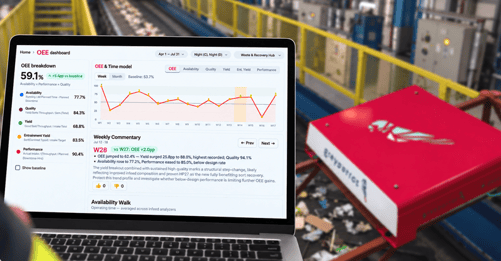
Instead of a sampler manually sorting and weighing a sample bag for a few minutes each shift, cameras positioned above a conveyor capture a live image feed. An AI model trained to recognise different material types – plastics, fibres, metals, and increasingly specific categories like food-grade vs. non-food-grade packaging – classifies every object it sees and estimates the mass of the stream.
The result is continuous, facility-wide visibility instead of an occasional snapshot. Where manual sampling might tell you what a bag of material looked like at 10am, AI waste analytics tells you what every line is doing, all day, every day.
.png?width=1000&height=562&name=gp5%20(1).png)
How does it work, in practice?
Three things distinguish a working AI waste analytics system, like Greyparrot Analyzer, from a camera pointed at a belt (see our full breakdown of how it works for a more technical walkthrough):
- A trained recognition model (the "taxonomy"). This is the library of material types the AI can identify. A system processing mixed municipal waste typically needs 60+ categories to be useful for detailed analysis. More specialised distinctions, like food vs. non-food-grade PET, require even finer-grained training. The taxonomy should expand over time as the model sees more material.
- Accuracy across two different metrics. Composition accuracy (how reliably the system identifies each material type) and mass or throughput accuracy (how reliably it estimates tonnage per material) are not the same thing, and a system can be strong at one and weak at the other. As a rough benchmark, composition accuracy above 98% and mass estimation accuracy above 90–95% are what a mature system should deliver, without dropping off at higher belt speeds.
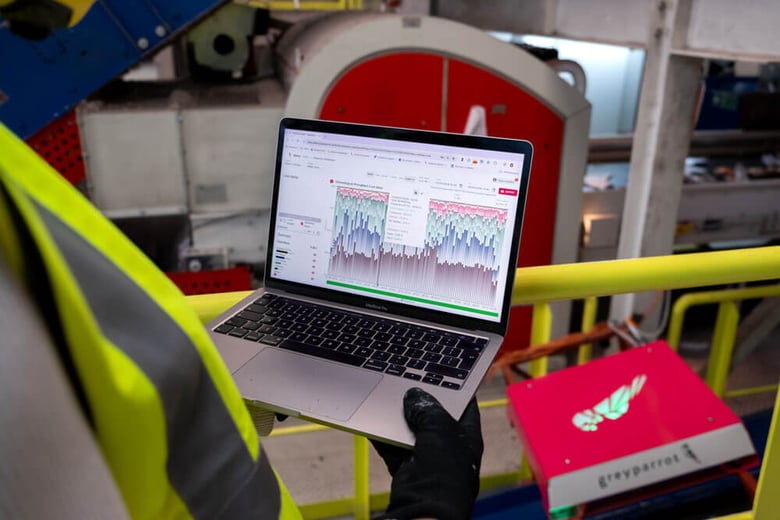
- Data that reaches the people who need it. Live dashboards, historical trend data, and open APIs that feed data into existing reporting tools (PowerBI, Tableau) or facility hardware (NIR sorters, balers, PLC systems) turn raw classification into something a plant manager, commercial team, or compliance officer can actually act on.
Retrofitting this kind of system onto an existing line is typically a matter of hours, not a facility rebuild – one advantage that's helped AI waste analytics scale to facility networks covering a meaningful share of Europe's waste management market.
What operational value can you expect today?
Full financial audits and cross-facility benchmarking are part of where this technology is heading, but plenty of the value is already being captured on the floor, today. By continuously identifying and quantifying waste streams instead of relying on an occasional manual check, operations teams can spot contamination sources earlier, adjust sorting routes based on live data rather than a best guess, and cut the hours spent on manual waste audits.
That same visibility feeds into commercial and compliance decisions too: paying suppliers or contractors on actual measured volume rather than an estimate, diagnosing bottlenecks on a line faster, and producing more accurate reporting for regulatory or ESG requirements. For many operators, that adds up to lower disposal costs and higher recycling yield – less a future promise than a function of finally being able to see, and act on, what's moving through the facility right now.
Not all AI waste analytics platforms are built the same
This is the part buyers often miss: two systems can both use cameras and both call themselves "AI," and still be solving fundamentally different problems.
Why the AI exists. Some AI is built to serve a single machine – telling a robotic arm where to pick, or an air jet when to fire. That's a legitimate and useful application, but the data it generates is a byproduct of sorting, usually count-based rather than a true mass balance, and scoped to whatever that one machine sees. A waste intelligence platform, by contrast, is built to answer a different question: not "where should this one object go," but "what is actually happening, financially and operationally, across this entire facility." One is action-oriented and machine-specific. The other is insight-oriented and facility-wide.
Where the AI sits. Point solutions typically sit at a single point in the process – usually the point of sort. That creates blind spots: you can see what that one sorter sees, but not the purity of the final bunker, or what's being lost on the residue line, unless you install a separate system at every point you want visibility. A platform approach sits at the beginning, middle and end of the line, giving a "macro" view of the whole facility rather than a "micro" view of one machine.
How deep the recognition model goes. A model trained narrowly for one sorting application, at one location, is effectively using a different sampling methodology for every stream it touches, which makes facility-wide or company-wide comparisons difficult. A single global model, trained on data pooled across many facilities, product streams and countries, produces a more consistent and more robust dataset, and can be standardised to the point where its output is accepted for regulatory reporting, as Greyparrot's data now is for UK Environment Agency compliance.
The practical takeaway for buyers: AI-enabled sorting machinery and an AI waste analytics platform aren't competing for the same job. Smarter individual machines are genuinely valuable. But someone still needs to check that those machines are doing what they're supposed to do, catch the value quietly slipping through as residue, and give the business a single, unbiased view of the whole plant. That's the role a dedicated platform plays.
What to look for when evaluating a provider
If you're assessing AI waste analytics for your own facility, a few questions tend to separate the systems worth shortlisting from the rest:
- Taxonomy fit: Does it recognise the specific material distinctions your business needs (e.g. food vs. non-food-grade packaging), and does the taxonomy grow over time?
- Accuracy, tested at your line speed: Ask for composition and mass accuracy figures, and confirm they hold at your facility's actual belt speed, not just in test conditions.
- Openness: Does it have a genuinely open API that can send data into your existing reporting stack and machinery, regardless of brand?
- Data continuity: Can it keep processing through a connectivity drop (edge computing), and does it give you both live and historical views?
- Track record: How many facilities is it actually running in, across how many countries, and can the vendor point to independently verifiable results, not just claims?
For a full walkthrough of this process, our AI buyer's guide covers all four stages in more depth, with input from plant engineers and CTOs who've been through it.
%20(1).png?width=1000&height=667&name=GP5%20(1)%20(1).png)
AI waste analytics: quick answers
Is AI waste analytics the same as AI-powered sorting?
No. Sorting AI drives a specific piece of equipment, like a robotic arm or optical sorter. AI waste analytics is a layer of insight that sits across the whole facility, independent of any one machine, and reports on composition, mass and value across every line.
How accurate is AI waste analytics?
Mature systems typically achieve composition accuracy above 98% and mass estimation accuracy above 90–95%, even at belt speeds up to 3m/s. Accuracy depends heavily on how diverse and how large the training dataset is, so it's worth asking any provider how many facilities and countries their model has been trained on.
Does it replace manual sampling entirely?
For most facilities, yes – some operators using AI waste analytics no longer run manual samples at all, since the system provides continuous data on every object processed rather than an occasional snapshot. That shift alone is what unlocks the day-to-day operational gains described above, from contamination tracing to supplier negotiation.
Can AI waste analytics data be used for regulatory compliance?
Increasingly, yes. In the UK, Greyparrot's data is already accepted for Environment Agency sampling reporting, but this depends on the accuracy and standardisation of the specific system, so it's worth confirming with any provider rather than assuming it applies universally.
Does it require new infrastructure?
No. AI waste analytics is typically retrofitted onto existing lines using cameras, without the need for new conveyor systems or major civil works – retrofits can often be completed within a few hours per line.
The waste sector spent decades automating how material moves through a facility. The next stage isn't just automating what happens to it next – it's finally being able to see, measure and act on what's actually there. That shift, from a handful of manual samples to a continuous, facility-wide dataset, is what's turning waste from a cost to manage into a resource to optimise.
Curious what this looks like on your own lines? See how Greyparrot Analyzer works.