
.png?width=780&height=532&name=Day-in-the-life-of-Tjerk%20(1).png)
When KSI Recycling deployed Greyparrot Analyzer units across their facility, the first thing Process Engineer Tjerk Wiersma did was look at trend lines.
Since deploying their first Greyparrot Analyzer units, the KSI Recycling team have made the Analyzer portal a cornerstone of their day-to-day operations. From early basic monitoring, Tjerk Wiersma has led deployment to today’s facility-wide data operating system – one that operators and process engineers rely on every shift.
The results are visible not just in performance metrics, but in the way the whole team now thinks about process management.
From trend lines to a full facility view
KSI's use of the Analyzer portal developed in stages, each driven by a new question the team wanted to answer.
Trend lines gave Wiersma’s team a baseline: a moving picture of material composition across their lines that manual sampling hadn’t been able to provide. But as the team grew more comfortable with the data, they wanted more precision in how they interpreted it.
After that, we wanted to pinpoint why those trends were happening. So we made an alert dashboard, and also a KPI dashboard."
– Tjerk Wiersma, Process Engineer at KSI Recycling
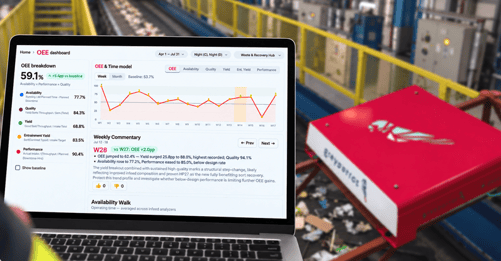
The alert dashboard translates continuous Analyzer data into clear diagnostic signals: if a target material drops below their purity thresholds, the dashboard turns red. If sorting is successful, the dashboard stays green. With live purity visible at-a-glance, team leaders can then decide whether to deploy extra sorting resources, slow throughput or inspect machinery in real time.
From there, KSI added Time Labels – the ability to segment data from specific shift intervals, and generate a summary of what happened during each period.
We wanted to know exactly what we did in that last time frame. Then you know: this came in, this went out, and this is how our sorting system performed."
– Tjerk Wiersma, Process Engineer at KSI Recycling
The most recent addition is a facility-level dashboard that gives Wiersma a view of mass balance across the entire sorting system: connecting each Analyzer unit so that infeed and output data can be calculated across the whole plant.
Every scanner we have can ‘speak’ with each other to calculate what is input and what is output, so we know exactly which materials are passing through the facility, and where they are being separated."
– Tjerk Wiersma, Process Engineer at KSI Recycling
Live data, close to ground truth
Since initial deployment, the Analyzer system has become even more accurate:
During the time we've worked with Greyparrot, you can see that the accuracy of the Analyzer and our manual analysis coming closer and closer."
– Tjerk Wiersma, Process Engineer at KSI Recycling
Today, Analyzer’s composition data deviates from the average manual sample by just 1.4 percentage points.
That alignment is operationally significant. Before Greyparrot, KSI had to wait one and a half weeks for manual sample results to come back from their quality team, and like most facilities, manual sampling was only ever capturing a fraction of total material flow. Now, the Analyzer delivers a live – and reliable – picture of what's happening on the floor at any given moment.
That is Greyparrot's biggest benefit. You have a live image of what we are doing right now in the process."
– Tjerk Wiersma, Process Engineer at KSI Recycling
Diagnosing problems in real time
For KSI's operators and team leaders, the portal has become the first place they look when something changes on a line. Two examples from Wiersma illustrate how the diagnostics work in practice.
On the PE line, the dashboard showed target material performing normally until 10am, then a sharp drop in quality. The operator identified a blockage on the valve. The data didn't just flag that something was wrong – it narrowed down where to look.
A second case involved Tetra Pak material accumulating in the residue line. The composition percentage of composite cartons was rising, but Wiersma team knew not to react to the percentage alone.
If you look only at the composition, you can tell that there’s a general problem appearing in residue. But that datapoint alone just tells us the symptom, not the cause.
If you also look at the tonnage, the amount of Tetra Pak cartons is increasing. That tells us to look for a problem in the Tetra Pak line specifically."– Tjerk Wiersma, Process Engineer at KSI Recycling
By reading composition and tonnage together, the team avoided a false diagnosis and identified the actual issue: a near-infrared light had broken down on the Tetra Pak sorting line. Once it was cleaned, replaced, and calibrated, performance recovered immediately.
This kind of multi-signal reasoning, comparing composition to tonnage, or infeed to output, is now standard for KSI's team. The portal gives them the layers they need to distinguish between a real process failure and a change in feedstock.
Curiosity as a competitive advantage
What stands out about KSI's use of Greyparrot is not any single dashboard or feature, it is the culture of curiosity that has grown around the data.
Wiersma and his team treat the Analyzer portal as an environment to test hypotheses, not just monitor outputs. If they want to understand the long-term effect of a process change, they examine a trend line across several months. If they want to assess a specific shift, they use time labels to isolate that window and dive into the data.
That engagement has spread across the facility. As Wiersma described in an earlier KSI case study, shift leaders that were previously reliant on intuition began using dashboards to make real-time decisions about machinery and staff allocation.
Their increasingly-sophisticated use of the Analyzer portal is what that made that possible: a layered, connected view of the facility that gives everyone from the process engineer to the team leader the right level of data for their role.
What KSI's approach shows the industry
KSI's journey from trend lines to proactive diagnostics is a model for how MRFs can extract full value from the data gathered by systems like Analyzer.
The data does not do the work on its own. KSI's results come from a team that was willing to interrogate the numbers, build new dashboards to answer new questions, and develop a shared language around what the data means.
That combination of technical infrastructure and human curiosity is what turns live material data into operational decisions, and operational decisions into recovered value. For MRFs looking to move beyond monitoring toward genuine process intelligence, KSI's approach shows what that transition looks like in practice.
.png?width=501&height=285&name=3.%202026-team-fun-photo%20(1).png)