Lessons from one of the first UK operators to submit AI-derived composition data directly to the Environment Agency.
When the MF Regulations were updated in England in October 2024, they did two things at once. They increased the frequency of sampling that facilities are required to carry out (adding to an already labour-intensive process), and for the first time they allowed composition data derived from AI to be used in submissions. For operators, this unlocked a big opportunity for efficiency.
In a recent webinar, we brought together Pedro Faraldo García, senior technical manager at FCC Environment, and Hannah Balacky, implementation lead at Greyparrot, to walk through how FCC Environment became one of the first operators in the UK to submit AI-derived composition data on an outbound stream directly to the Environment Agency (EA), as part of its Q1 2026 compliance reporting. What follows is a summary of that conversation: the reasoning behind the project, how the data was validated, and what it signals for the wider industry.
A regulatory shift that rewards continuous data
The updated regulations increased sampling requirements at a time when many facilities are already stretched. But the same update opened a genuinely new route. As the EA puts it: “there are no restrictions to the use of visual detection and recognition technology for MRF sampling, including artificial intelligence technology.”
Crucially, the responsibility for trusting that data stays with the site.
“The EA is technology-agnostic. So it's a bit up to you, the operator, to choose your methodologies and technologies, and you being comfortable with the data.”
Pedro Faraldo García, Senior Technical Manager, FCC Environment

The problem with sampling a snapshot
Manual sampling covers less than 1% of the material passing through a facility. It is also demanding work, and a single anomaly can skew an entire sample. Pedro described the effort involved:
“Manual sampling involves a lot of effort. It's not just the sampling or the sorting itself. It involves collecting the sample, creating a representative sample by quartering. There's a lot of handling involved. And the current approach only provides you a snapshot in time.”
Pedro Faraldo García, Senior Technical Manager, FCC Environment
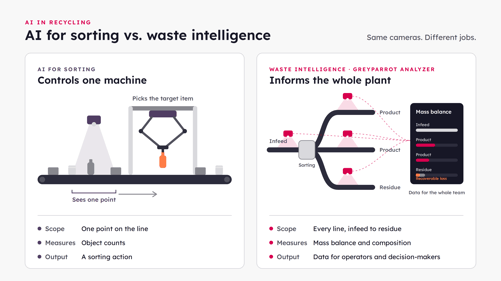
The Greyparrot Analyzer takes a different approach: the same technology now running across more than 250 installations in 20+ countries. Camera units powered by AI sit above the conveyor and monitor the stream continuously, for as long as the plant is running. That means the data reflects the whole stream rather than a random spot check, turning sampling from an occasional snapshot into a continuous record. For Pedro, that was the real draw:
“This project was not just about reducing the manual labour. It was a bit more about exploring the better collection of data and the opportunities that will bring to us.”
Pedro Faraldo García, Senior Technical Manager, FCC Environment
%20(1).png?width=1000&height=667&name=GP5%20(1)%20(1).png)
Proving the data holds up
Confidence in the numbers is what makes AI-derived reporting auditable. Hannah's team built a structured onboarding process (typically four to six weeks) across five phases: project kickoff, camera calibration, portal setup, mass calibration, and validation. Along the way, Greyparrot's taxonomy of more than 100 waste classes is mapped into the EA's reporting categories, and detections are split by size so that Analyzer data and manual samples are compared like for like.
The validation stage has evolved through several iterations and now rests on a suite of statistical tests designed to account for the natural variability of different waste streams. On top of that, every prediction and image is retained:
“A large advantage of using AI is that you can actually audit it. All of the predictions are saved on the cloud, all the images are saved on the cloud. We even have a feature called line replay, where you can go back to any moment in time and watch the video go past with the detections on.”
Hannah Balacky, Implementation Lead, Greyparrot

What submitting to the EA actually looked like
FCC chose its mixed plastics stream (a harder test than, say, PET bottles or cans) to prove the concept properly. Ahead of submission, the team informed the EA of the approach and shared the methodology and initial validations. The process was straightforward.
“We chose the mixed plastics because it was a stream we considered feasible, but we also wanted to give ourselves a bit of a challenge. Whatever we were ready to submit to the EA involved us being absolutely confident that the data was comparable enough.”
Pedro, FCC Environment
Because Analyzer data can be exported straight into the EA's required return format, the reporting step itself becomes a copy-and-paste job rather than a manual reformatting exercise, removing another point of friction from the quarterly cycle.
Beyond compliance: reading the stream in real time
With Simpler Recycling already reshaping what arrives on MRF floors and a Deposit Return Scheme on the horizon, the composition of incoming material is set to keep shifting. Continuous monitoring gives operators a way to see those changes as they happen, and the same Analyzer data that supports compliance also supports day-to-day operations, from spotting a drop in output quality to flagging when a belt is running empty.
"In a scene of changing regulations (and we know waste changes all the time), what is coming in the next one to two years, with DRS kicking in and all this new legislation, is going to be quite a challenge for MRFs. We see the potential for these systems to assist us in future upgrades of plants, new equipment to deal with new materials, assessing the impact of DRS, or changing operational practices."
Pedro, FCC Environment
His advice to other operators was less about the technology and more about the people around it:
“Bring your operational teams and management on board with the value of the data and learn how to use it. This is not just a data-gathering exercise; it's something that has practical and operational value.”
Pedro, FCC Environment
A milestone for the industry, not just one facility
FCC Environment's submission is among the first of its kind in the UK: a working demonstration that continuous, AI-derived composition data can meet a regulator's bar for compliance. As more facilities follow and more data reaches the EA, the industry moves closer to reporting that is representative, auditable, and continuous by default. For a sector that has long made decisions on a fraction of a percent of its material, that is a meaningful step toward closing the visibility gap.
Watch the full conversation on demand
Hear the full discussion with FCC Environment and Greyparrot, including the audience Q&A on tolerances, input sampling, and applying the approach across other sites.
.png?width=501&height=285&name=greyparrot-nycw%20(1).png)