

The headline number seems good and bad depending on the audience
The study found that 68% of aluminium aerosols reach the correct material stream at a materials recovery facility (MRF), where mixed household recyclables are separated. Used beverage cans, on the same equipment in the same facilities, reach it 85.3%. That difference, 17.3 percentage points, is the gap the session was convened to explain.
Ian McSpirit, whose employer handles around 30% of the UK's recyclables passing through MRFs, was direct.
"To be frank, it's a bit disappointing. But it's a new number that we've never seen in this kind of detail before. That's lost opportunity for us. It's lost material that could be going off for recycling, and it's an increased cost for disposal."
Tom Giddings then reframed it. The 68% describes only aerosols that reach a MRF, and Alupro's evidence puts household capture at 55% to 60%.
"So what we're actually looking at is 68% of 60%." - Tom Giddings
Takeaway: quoting 68% as a recovery rate overstates performance by roughly a third. Kerbside capture is the larger loss, and it is addressed through consumer communication rather than design.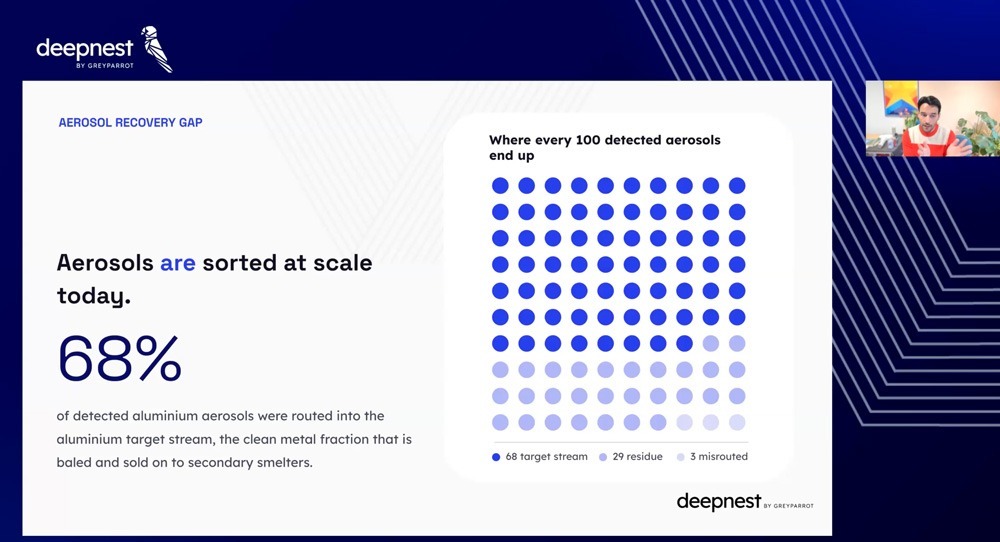
The finding the panel did not expect was deformation
The gap drew most of the pre-session attention. On the day, the figure that changed the conversation was deformation: 88% of the aerosols we detected arrived already misshapen.
"Nearly all conversations I have around this assume that they retain their rigid shape until they're bailed and crushed," Tom Giddings said. "This opens up a new avenue for debate concerning how materials in general, not just aerosols, behave after collection but before sorting. It opens up a lot of avenues for discussion around EPR fees."
It also carries a safety question. From 2027 the deposit return scheme (DRS) will pull most beverage containers out of UK kerbside collections, leaving a non-beverage aluminium stream in which aerosols account for a far greater share than today. Deformation could tell operators whether that concentration matters: if a deformed can reliably indicates an empty, depressurised one, they gain a physical check.
"That would help answer something we have a real nervousness around: how do our current plants cope with the changes that DRS brings, and what is it that we need to do to make sure that we're safe and that the operations are safe going forward," Ian McSpirit said.
The link is not established, and Tom Giddings cautioned that DRS will take years to bed in, leaving aerosols "the junior partner" in the remaining stream for some time. But as he put it, "it could change the maths."
What the numbers prove, and what they do not yet explain

Predrag Ozmo from Ball, who manufactures aerosol cans, welcomed the evidence before arguing against the simplest reading of the number.
"What's very valuable about this study is that it starts to quantify the differences in real operating facilities, something we don't see very often. That is a super important and great step forward for the industry."
- Predrag Ozmo
His caution was about attribution. "We need to be careful about attributing the gap of 17.3% to the packaging itself only, because we have different collection systems, different sorting technologies, different operating practices, and potentially different downstream requirements."
The Netherlands already runs a deposit return scheme, changing what the conventional stream contains. Aerosols are also more complex by construction: different geometries, thicker walls, alloys, valve systems, and components in nylon, rubber, plastic and steel.
"There is a distinction between design for recyclability and designing around the limitation of a particular recycling facility. Before changing a design, we need real reliable evidence that the change actually improves recycling, recovery, collection and downstream processing."
- Predrag Ozmo
He summarised it: "The real goal is real recycling, not just technical recyclability in some specific conditions."
Takeaway: the value of real-world measurement is locating where material is lost, not a single headline figure. Facility and market breakdowns turn a finding into a design decision.
Three design variables worth testing
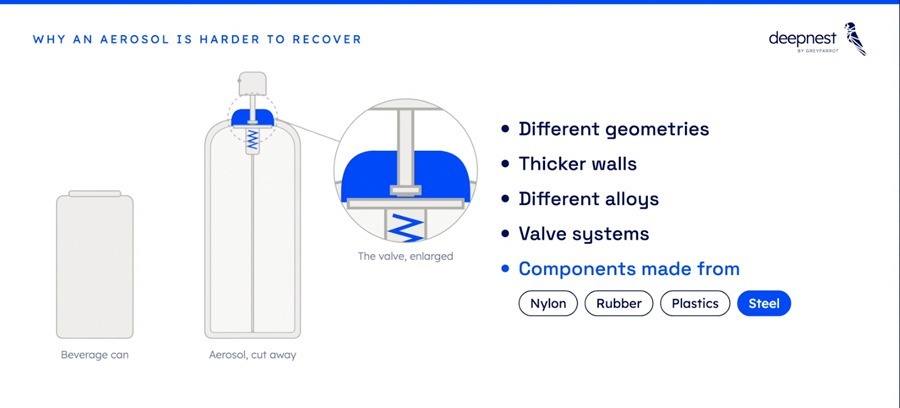
Aerosol aluminium is a high-purity alloy and valuable as feedstock, which makes everything attached to it a yield question.
"There is a wider question around designing out components that are not of that type of material, looking to rationalise the material portfolio wherever possible, to maximise the yields that you'll get," Tom Giddings said.
That is not settled. Asked whether aerosols would be better made entirely of one material, Ian McSpirit suggested the opposite may prove true: "It may be that physical characteristic of the small ferrous cap, the small ferrous actuator, is actually a characteristic we want to retain... That perhaps is a solution for removing aerosols away from the beverage can stream." In a post-DRS stream, the apparent contaminant could become the means of separating aerosols out.
The second variable is detachment, or what the session came to call ‘popability’. Half the aerosols we detected arrived with no actuator, and capped formats frequently arrived without the cap. A component that separates during collection can be recovered as plastic rather than carried into the aluminium stream. That is a design choice, not a consumer instruction. Shown a trigger-spray format, Tom Giddings noted it may suit someone with limited grip, and warned against shifting the burden. "We don't want people disassembling things that aren't designed to be disassembled."
The third is wall thickness, the least examined of the three. Ian McSpirit suspects it influences sortability, the proportion of units reaching the correct material stream, more than anyone has quantified.
"The more weight of aluminium the eddy current can work on, the more likely we'd expect it to be successful. So it may be a small change in wall thickness that has a significant impact on sortability."
- Ian McSpirit
Takeaway: material rationalisation, component detachment and wall thickness can all be measured against real recovery data. They belong in the design brief alongside material choice.
Measurement is the underlying shift
Ian McSpirit explained why this evidence did not exist before.
"There's an old adage in manufacturing that you can't control what you don't measure. This is the first time we can measure, we can analyse, and we can see at scale. It's the difference between a Polaroid photograph of a few seconds of processing versus a 4K video of what happens 24/7."
None of the questions raised are settled. What has changed is a baseline precise enough to test a design decision against, rather than a model of how a pack should behave. For teams reviewing an aerosol portfolio, the next step is to establish how their own formats perform in real recovery facilities before committing to a specification change.
Download The Aerosol Recovery Gap report below to have access to the data behind the discussion.
Interested in paper cup recycling? Check out our upcoming UK Composite Fibre Report.