What this webinar is built on
Aluminium is described as infinitely recyclable. That claim says nothing about whether a given aerosol reaches a smelter.
Under the EU's Packaging and Packaging Waste Directive, non-beverage aluminium formats face a mandatory 60% recycling target by 2030. Until now, the aerosol category has had little empirical data on how it performs in real recovery systems. The result is that design for recyclability decisions on aerosols have been made against fragmented data.
Deepnest published the first global large-scale study of aerosol end-of-life performance, drawing on 395,424 aluminium aerosol units detected within 1 trillion waste objects across materials recovery facilities and plastics recovery facilities in the US, the UK and the Netherlands. It measures form factor in detail, including whether units arrive crushed or intact and what survives the journey, and it benchmarks aerosol performance directly against aluminium beverage cans running through the same facilities.
Register for the panel
This panel brings together packaging and sustainability leaders from across the CPG sector to discuss what the findings mean in practice: where aerosol recovery already works, where it breaks down, and which design decisions are worth making now.
Panel speakers
.png?width=150&height=150&name=Tom(small-headshot).png)
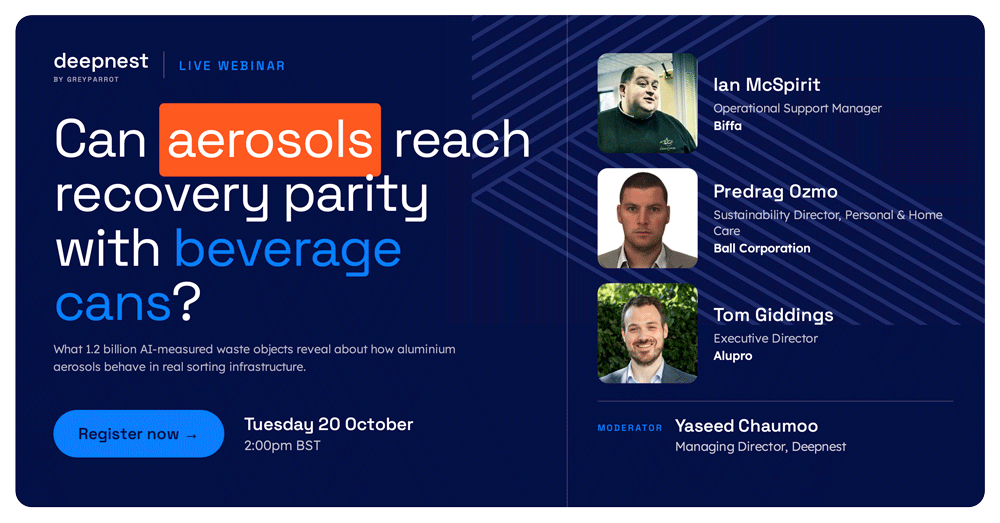
Tom Giddings
Executive Director, Alupro
Tom works with government, industry and local authorities to drive improvements in packaging recycling and support the UK's transition to a more circular economy. He has held sustainability roles at paper and cardboard packaging giant DS Smith, giving him first-hand experience of the commercial and environmental challenges facing the packaging sector.

Predrag Ozmo
Sustainability Director for Personal & Home Care and Growth Ventures,
Ball Corporation
Predrag leads global sustainability strategy for aluminium aerosol packaging, aluminium bottles, and circular business models at Ball Corporation. He works with leading consumer goods companies to advance decarbonization, circularity, recycled content, and responsible sourcing across the aluminium value chain.

Ian McSpirit
Operational Support Manager - Recycling, Biffa
Ian McSpirit leads plastics recovery operations at Biffa, one of the UK's largest waste management companies. Previously a site manager and most recently Head of Polymer Recovery Facilities, he has championed the use of real-time AI waste analytics across Biffa's PRFs. That work includes monitoring PET purity and helping Biffa become one of the first UK operators to use AI-derived composition data in Environment Agency compliance reporting.
Moderated by

Yaseed Chaumoo
Managing Director, Deepnest by Greyparrot
Yaseed Chaumoo is a seasoned entrepreneur, AI expert, and investor with a strong background in product development and commercialisation. He co-founded and successfully exited an AI SaaS startup acquired by a FTSE 250 company, and has over a decade of experience in AI, spanning predictive analytics, generative models, and AI adoption strategies. As Managing Director at Greyparrot, he leads AI-driven innovation in waste analytics, helping large CPG and FMCG’s to understand post consumption data to drive more sustainable actions.
Join the Deepnest aerosol panel webinar
Register now to hear how packaging and sustainability leaders are reading the new data, and what it means for aerosol design ahead of the 2030 recycling target.
20 October | 2 pm