

Consumers won't pay a premium, but they will assign blame
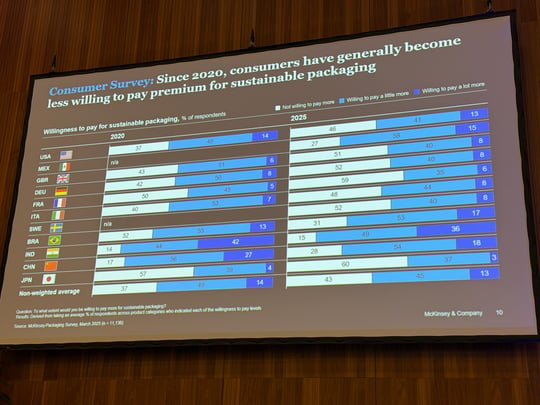
A McKinsey & Company partner opened the programme with findings from a survey of 11,136 consumers across North America, Europe, Latin America and Asia. Price remains the top purchase factor. Recyclability is the packaging trait consumers most associate with sustainability, ahead of recycled content and reuse.
Willingness to pay has fallen since 2020: in the US, the share of consumers unwilling to pay any premium for sustainable packaging rose from 37% to 51% between 2020 and 2025, while those willing to pay "a lot more" fell from 14% to 8%. The one reliable uplift comes from bundling a sustainable product with sustainable packaging, not from packaging claims alone.
The sharper finding was about blame. Asked who is responsible for packaging sustainability, consumers named brand owners first and packaging producers second, well ahead of regulators.
Takeaway: the commercial case for sustainable packaging isn't a price premium, it's the cost of being the name consumers blame when a pack fails at end-of-life.
The design decision is where the fee gets set
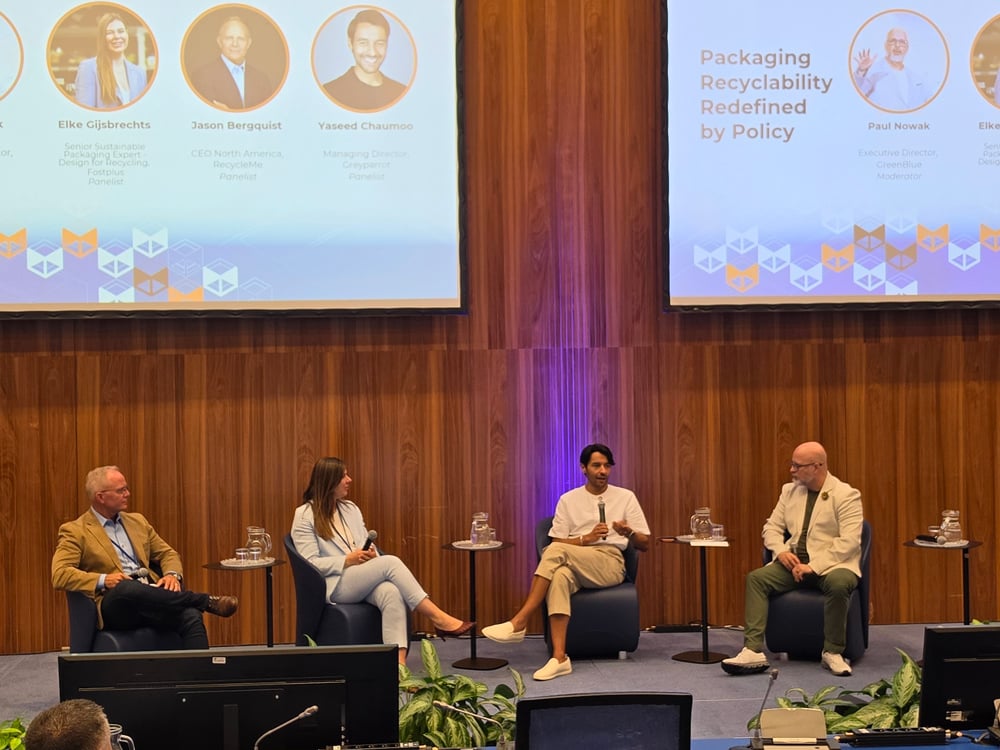
A panel bringing together FostPlus (the Belgian producer responsibility organisation), Deepnest and an EPR advisory practice supplied the design-side answer. FostPlus estimates that around 80% of a pack's environmental impact is locked in at the design phase, and materials that are "perfectly recyclable on paper" routinely fail in practice: carbon-black pigments blind the optical sorters that materials recovery facilities use to separate materials by type, and some formats jam the machinery outright.
The UK's reclassification of coloured PET from amber to red, days before the forum, made the point concrete. Recyclability now runs on a red-amber-green scale tied to PPWR, and eco-modulation links a design's grade directly to its EPR fee. The question for a design team is no longer pass or fail, but which shade clears the recyclability threshold, and that's only answerable with real-world recovery data.
This is where sortability, Deepnest's term for the proportion of packaging units that actually get sorted into the correct stream at recovery facilities, becomes the metric that matters. Deepnest's data, drawn from over 250 Greyparrot Analyzer units deployed across 65+ global recovery facilities, exists to answer that question at the level of a specific format and colour, not a material category.
Takeaway: if most of the impact and the fee exposure is set at design, and "recyclable" depends on the exact variant in a specific system, the design decision that matters most is the one you can least afford to make blind.
Materials keep shifting, and the evidence bar keeps rising
PPWR's design-for-recycling regime rewards more recyclable formats and penalises less recyclable ones. Constantia Flexibles' VP of sustainability said the regulation will "fundamentally change how we design packaging," noting close to three-quarters of the company's volume already meets current design-for-recycling criteria. Mars' global circular packaging director put the financial edge bluntly: PPWR in Europe and SB54 in California both attach a real cost to plastic packaging, large enough to reopen material choices that once looked settled.
A RecyClass panel added that recyclability is increasingly judged on what is genuinely recovered, not just collected, and that the amber middle of the red-amber-green scale is the hardest to manage. PPWR now requires a declaration of conformity that travels with the pack, and, as one speaker put it, "you cannot give a certificate unless you really know what you are doing."
The same caution applied to the swing from polymer to fibre. Senior voices from Mondi, Mars and Huhtamaki were unanimous that there's no generic material answer, only application-specific ones, and that coated fibre must not sacrifice the recyclability that justified the switch in the first place. Flexible packaging remains the hardest case of all: it makes up more than half of FMCG packaging on European shelves, has the worst image with consumers, and a UK kerbside trial across 20-plus brands found that residents will separate it, but collection still isn't recycling without consistent feedstock.
Takeaway: a recyclability rating is now a fee multiplier and a compliance artefact at once, and neither a material switch nor a "recyclable" claim can be defended on spec sheet alone. Both need evidence of real-world outcome.
AI's promise runs into the same data gap
A Bain & Company partner ran a live benchmark showing around 95% of the room believe AI can transform sustainable packaging, a third are piloting it, and none have embedded it at scale. Generative design is already cutting R&D cost 10–20% and compressing innovation cycles from roughly two years to about 100 days.
Of the bottlenecks holding AI back, he named data first: "garbage in, garbage out." On what happens to packaging after consumption specifically, he was blunt: "there's not a lot of information. Consumer products companies don't know." Greyparrot was among the technologies he cited as closing that gap.
Takeaway: AI doesn't remove the data problem, it raises the cost of leaving it unsolved.
Everything came back to end-of-life visibility
Every session, whatever the subject, ran on data, and the quality of the decision was capped by the quality of the underlying dataset. Yet the data most packaging teams hold is strongest at the point of placing a product on the market, and thins out exactly where it now matters most: what happens once a consumer is done with the pack.
Converge Vienna's message echoed the one heard in London two months earlier. Packaging decisions are now judged on evidence, and the consequences, fees, conformity and reputation, arrive quickly. Fitting a pack to local systems, defending a material claim, proving a flexible is recyclable and building an AI use case all depend on knowing, not assuming, how a pack behaves in the real recovery system. For most teams, that is still the least visible part of the picture, and it's the part the regulations, the ratings and the technology are now all pointing to.
Deepnest by Greyparrot helps brands, retailers and packaging producers design more circular products with packaging waste intelligence. Learn more.