

The Deepnest team traveled to Birmingham for this year’s Food & Drink Expo, setting out to answer some of the industry’s most pressing questions. What new packaging formats are set to dominate production? How is AI vision technology changing the way retailers measure operational success? And – crucially – how is the UK supply chain bracing for the imminent Deposit Return Scheme (DRS)?
After speaking directly with packaging teams, sustainability leaders and operational innovators, we found the answers.
Formulation mechanics: The era of health optimisation and its impact on packaging
Across the conference, new beverages and snacks were enhanced with additions like protein and probiotics, signalling a decisive shift towards products aimed at “health optimisation”. This shift directly influences modern packaging strategy.
These highly active, sensitive compounds place pressure on structural design, requiring advanced packaging formats that protect their health benefits. Without elements like strict UV and oxygen barriers, the efficacy of functional ingredients degrades long before they reach the consumer.
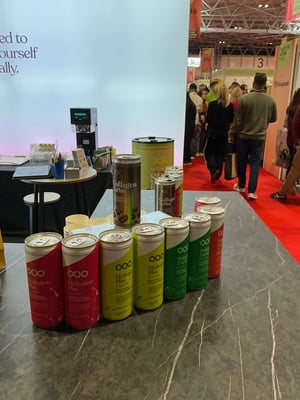
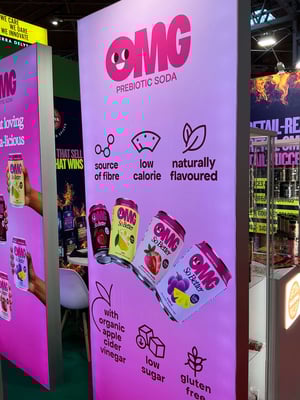
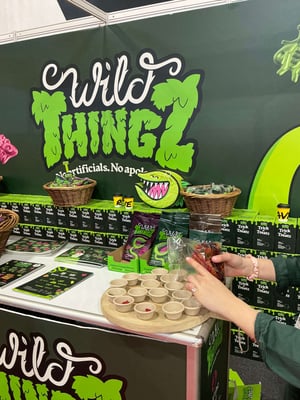
More precisely, high-density amino acids and added vitamins are highly susceptible to photo-oxidation, meaning that packaging must act as an absolute UV barrier. At this year’s conference, nearly 100% of these functional liquids were housed in opaque formats. The dominant solutions for this new vertical are currently difficult-to-recover formats like multi-layer cartons and fully-sleeved PET bottles, though some opted for widely-recycled aluminium cans. Clear PET was virtually non-existent in this category, suggesting that aluminium may provide the best balance between UV protection and recyclability.
Specific food & drinks trends observed at the Expo:
- Prebiotics and complex botanicals: The beverage sector is undergoing a functional carbonation change. The rise of "fibre sodas" is evident in OMG Bubble Tea’s ’s new "OMG So Better" line, marking a clear transition from high-sugar formulas to functional refreshment. Flavour profiles are also pivoting; one industry expert we talked to confirm that cherry is emerging as a statistically dominant base note across multiple verticals, with rhubarb steadily gaining ground.
- Adaptogenic integration: Exhibitors are proposing complex botanical integrations. For instance, OQO drinks are utilising the resin Shilajit to target energy optimisation and stress reduction. Ukrainian brand Spraga continues to iterate within the kombucha space, showcasing sophisticated new flavour profiles like pomegranate and apple-pear. Similarly, adaptogens are moving from niche to mainstream, with brands like Feel Alive successfully leveraging functional mushroom extracts.
- Functional snacking: Confectionery and breakfast categories are being transformed for functional output. Brands like Wild Thingz are formulating sweets within strict health parameters that appeal to a growing number of families that are more conscious about their health, while Poridj is integrating prebiotics into traditional oat-based formats, emphasising ambient convenience without compromising on taste.
Plant-based sector stabilisation

- Dairy alternative maturation: In the dairy-free space, Irish brand Oatier provided a masterclass in this maturation phase. By using 100% pure Irish oats and a bespoke extraction process, they have engineered a Barista Oat Drink that competes on the creamy texture required by modern coffee shops. This illustrates the industry's broader pivot toward ingredient quality and regional provenance over sheer novelty.

- Savory substitutes: Legacy and emergent brands in the meat-alternative space are cementing their positions by refining the eating experience. Cock and Bull, with their Chili Con, is increasingly building presence in the savory vertical, alongside established, clean-snacking brands such as Eat Real veggie straws.
Material science and micro-manufacturing
From a packaging and product engineering perspective, the structural mechanics of consumer goods are undergoing a forced evolution. This shift is primarily driven by impending regulatory pressures, increasingly rigorous material lifecycle analysis, and the physical demands of automated hardware:
- The mono-material transition: There is a strong shift towards bio-based materials and mono-material formats, which are increasingly replacing less-recyclable composites. This year’s Expo provided several examples of the trend, including Capri Sun’s strategic transition toward mono-material PP pouches.
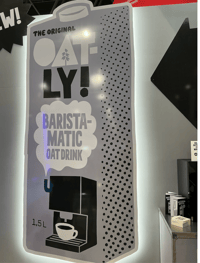
- Hardware-optimised liquid engineering: Beyond packaging, products themselves are being structurally re-engineered for hardware compatibility. A prime data point for this shift is Oatly’s new Baristamatic 1.5L. Presented as the "world's first oat drink made for automated coffee machines," it represents a fundamental intersection of material formulation and automated infrastructure. Historically, plant-based milks have suffered from high sedimentation rates that clog the internal tubing of coffee dispensers. By balancing a specific ratio of premium oats and rapeseed oil, Oatly has successfully eliminated this mechanical failure point. They are no longer just formulating a liquid for human taste; they are physically adapting a material explicitly so that it is optimised for machine transit and automated dispensing.
The infrastructure overhaul (AI, automation, and DRS)
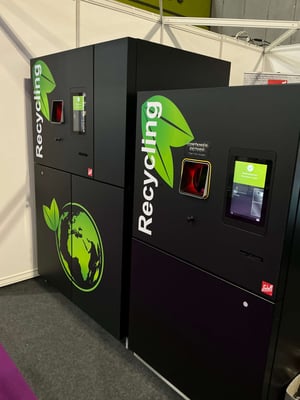

While product improvements drive consumer interest, the operational undercurrent of the expo was focused on systemic changes – specifically the imminent UK Deposit Return Scheme (DRS). The UK’s DRS will apply to PET plastic and metal beverage containers from the 1st of October 2027, driving a new wave of hardware and software solutions adoption to support the change:
Collections infrastructure
With Ireland serving as the successful, real-world reference model for national rollout (having achieved 1.2 billion containers returned in one year) the UK market is actively working to determine its logistical framework. This was reflected in the concentration of Reverse Vending Machine (RVM) manufacturers exhibiting at this year’s expo.
The primary objective for hardware suppliers is securing retailer buy-in, and establishing their units as the standard reference machines before the legislation takes full effect. The solutions that succeed will help define beverage format best-practice in the coming years.
AI waste recognition technology
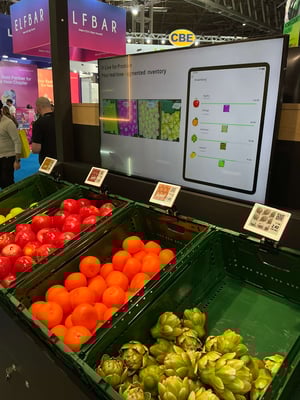
The increasing deployment of AI vision technology and automated retail infrastructure ran parallel to hardware developments at Food & Drink Expo.
Exhibitors showcased advanced optical systems engineered to quantify operational metrics in real-time. These AI networks are designed to address challenges from inventory management to retail shrinkage – as well as the increasingly-urgent need to account for packaging’s end-of-life, and design more circular formats.
While the primary commercial focus of the expo was on product development and shelf penetration, the Deepnest team had many conversations that pointed towards a rapidly-growing interest in recyclable packaging innovation. Brands and retailers are conscious of the impending impact of Extended Producer Responsibility (EPR), and are looking for ways to operationalise circular design improvements alongside their brand and commercial priorities.
Some of the world’s largest FMCGs are now turning to Deepnest to strike that balance. To learn how packaging waste intelligence is helping their teams navigate the mono-material transition, optimise their packaging for automated retail hardware, and future-proof their ecosystem ahead of the DRS deadline, you’re welcome to arrange a meeting with us below.

Hardware-optimised liquid engineering: Beyond packaging, products themselves are being structurally re-engineered for hardware compatibility. A prime data point for this shift is Oatly’s new Baristamatic 1.5L. Presented as the "world's first oat drink made for automated coffee machines," it represents a fundamental intersection of material formulation and automated infrastructure. Historically, plant-based milks have suffered from high sedimentation rates that clog the internal tubing of coffee dispensers. By balancing a specific ratio of premium oats and rapeseed oil, Oatly has successfully eliminated this mechanical failure point. They are no longer just formulating a liquid for human taste; they are physically adapting a material explicitly so that it is optimised for machine transit and automated dispensing.
Dairy alternative maturation: In the dairy-free space, Irish brand Oatier provided a masterclass in this maturation phase. By using 100% pure Irish oats and a bespoke extraction process, they have engineered a Barista Oat Drink that competes on the creamy texture required by modern coffee shops. This illustrates the industry's broader pivot toward ingredient quality and regional provenance over sheer novelty.
Savory substitutes: Legacy and emergent brands in the meat-alternative space are cementing their positions by refining the eating experience. Cock and Bull, with their Chili Con, is increasingly building presence in the savory vertical, alongside established, clean-snacking brands such as Eat Real veggie straws.
Material science and micro-manufacturing
From a packaging and product engineering perspective, the structural mechanics of consumer goods are undergoing a forced evolution. This shift is primarily driven by impending regulatory pressures, increasingly rigorous material lifecycle analysis, and the physical demands of automated hardware:
The mono-material transition: There is a strong shift towards bio-based materials and mono-material formats, which are increasingly replacing less-recyclable composites. This year’s Expo provided several examples of the trend, including Capri Sun’s strategic transition toward mono-material PP pouches.
Hardware-optimised liquid engineering: Beyond packaging, products themselves are being structurally re-engineered for hardware compatibility. A prime data point for this shift is Oatly’s new Baristamatic 1.5L. Presented as the "world's first oat drink made for automated coffee machines," it represents a fundamental intersection of material formulation and automated infrastructure. Historically, plant-based milks have suffered from high sedimentation rates that clog the internal tubing of coffee dispensers. By balancing a specific ratio of premium oats and rapeseed oil, Oatly has successfully eliminated this mechanical failure point. They are no longer just formulating a liquid for human taste; they are physically adapting a material explicitly so that it is optimised for machine transit and automated dispensing.