
.png)
A credibility milestone for the data
The EA's position on AI for MF sampling is unambiguous: there are no restrictions on the use of computer vision, provided operators can demonstrate the methodology produces representative results. Biffa and FCC's Q1 submissions are the first material demonstration of that standard being met at commercial scale in the UK.
For brands trying to understand what actually happens to their packaging once it leaves the kerbside, this is the moment continuous, AI-derived waste intelligence crossed a credibility threshold. It is no longer simply an interesting operational input. It is now evidence the regulator will accept on questions of statutory weight.
Lab tests and software-based recyclability models predict sortability under controlled assumptions. Continuous waste intelligence — generated shift by shift, against a methodology a regulator has reviewed — observes what actually happened. As the financial stakes attached to packaging performance rise, the distinction between the two becomes commercially material.
The bridge to EPR
The EA sits in close regulatory relationship with the Department for Environment, Food and Rural Affairs (DEFRA) and Packaging UK (PackUK), the scheme administrator running UK EPR. Acceptance of the methodology at the infrastructure reporting layer does not automatically carry across to packaging-side compliance, but it sets a precedent. If continuous, AI-derived composition data is robust enough to support MF compliance, the case for accepting it as evidence in EPR contexts becomes considerably stronger as that framework matures.
UK EPR is now live, and eco-modulation (fees calibrated to the recyclability of each packaging format) is being actively developed. Two questions are sharpening for every CPG brand placing packaging on UK shelves:
- How is my packaging actually performing in the recovery systems my fees are funding?
- What evidence can I bring when challenged on that performance, or when modulated fees are calculated against assumptions I would dispute?
For both questions, the answer that will hold up under scrutiny is one grounded in continuous, facility-level data rather than periodic manual sampling.
The system being measured is itself in transition
There is a second reason for brands to pay close attention now, separate from the evidential question. The recovery system in which their packaging is sorted is in active transition:
- The 2024 MF Regulations update introduced more detailed infeed and outfeed reporting requirements, which is what created the operational pull for AI-derived data in the first place.
- Simpler Recycling extended to households in March 2026, mandating separate fibre collection and changing the material mix in every recycling stream a brand's packaging passes through.
- In 2027, flexible plastics and fibre-based composite cartons enter kerbside collections, introducing categories most materials recovery facilities (MRFs, the plants where mixed recyclables are sorted) are not yet equipped to capture cleanly.
- The UK Deposit Return Scheme launches in October 2027 on drinks containers, redirecting high-value PET bottles and metal cans away from kerbside streams entirely.
Each of these shifts changes the conditions under which a packaging SKU will be sorted. A format that performs reliably in today's stream may not perform the same way next year. Colour, coating, polymer choice, and pack format each move sortability outcomes in measurable ways, and design assumptions calibrated to the current system carry risk into the next one.
The size of the gap between design intent and recovery reality is already visible in the data. Deepnest's analysis of over 17 billion waste objects across UK facilities processing roughly 20% of England's recycling stream finds that, while 76% of paper and card is classified as widely recyclable by PackUK, 29.3% of fibre is still leaving facilities in the residue line, destined for landfill or incineration. The gap reflects the difference between policy classification and operational reality: contamination, equipment limitations, and the way fibre interacts with other materials in mixed streams all push items that are technically recyclable out of the recovery loop.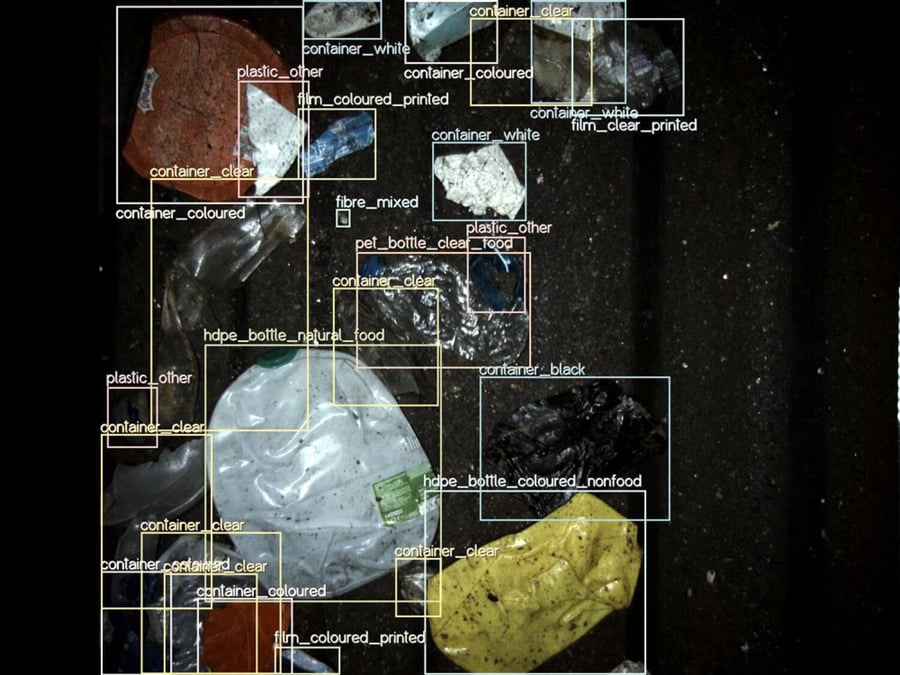
Takeaways for packaging teams
If continuous, regulator-grade waste intelligence is becoming the new evidential floor, the brands best positioned over the next 18 to 24 months will be those that can act on four fronts:
- Quantify sortability portfolio-wide. Measure performance for each material and format against the actual recovery infrastructure that processes it, not against lab-based proxies.
- Identify the highest-ROI design changes. Colour shifts, sleeve removals, material substitutions, and format adjustments move sortability outcomes by different margins. Knowing which lever moves the needle most efficiently per pound spent is now a quantifiable question.
- Build a defensible evidence base. Recyclability claims and modulated fee positions will increasingly be tested against auditable, third-party-verifiable data. The brands that can produce it will be the ones contesting the figures rather than absorbing them.
- Make the investment case on observed ROI, not predicted ROI. The internal business case for circular packaging investment changes when sortability gains can be measured directly, not modelled.
These are commercial questions as much as sustainability ones. They sit with packaging directors, finance, and regulatory affairs alongside sustainability teams.
A new evidential floor for packaging performance
The Biffa and FCC submissions mark the point at which AI-derived waste intelligence entered the live UK regulatory record. As UK EPR develops and the recovery system underneath it continues to shift, the bar for what counts as defensible evidence on packaging performance is rising, and the gap between brands operating on prediction and brands operating on observed, real-world data will widen.
For packaging teams, the next 18 to 24 months are when that gap turns into measurable cost difference, on EPR fees, on recyclability claims, and on the speed at which design decisions can be defended.
Deepnest tracks the fate of packaging across global recovery facilities, giving brands the continuous, auditable waste intelligence needed to align packaging design with the recovery reality their fees are calibrated against. To understand how your portfolio is performing, and what is likely to change as the regulatory and infrastructure landscape evolves, speak to the Deepnest team.